 Skip to content

A single-storey kitchen extension in Ireland costs between €55,000 and €200,000 in 2026, depending on the size, the finish and where you build. Most projects sit in the middle of that band, and Dublin tends to land at the top. Two-storey extensions cost more again.
This guide breaks down what you actually pay, from the per square metre rate to the full all-in figure, plus the planning rules that changed in 2026. One thing is worth knowing up front. Most overspends start because the real cost is worked out after the design, not before it.
How Much Does a Kitchen Extension Cost in Ireland in 2026?
A typical single-storey kitchen extension in Ireland costs €55,000 to €200,000 all-in, covering the build, a fitted kitchen, professional fees and VAT. Size is the biggest lever. A small extension starts near €55,000, while a large open-plan build in Dublin can pass €200,000 once you add a high-end finish.
Here is how the all-in cost usually breaks down by size.
| Extension size | Best suited to | Typical all-in cost |
| Small, 15 to 20 m² | Side return or galley kitchen | €55,000 to €90,000 |
| Standard, 25 to 30 m² | Open-plan kitchen and dining | €90,000 to €145,000 |
| Large, 35 to 45 m² | Kitchen, dining and living space | €140,000 to €200,000 |
These are all-in figures. They cover the structural build, a mid-range fitted kitchen, design and engineering fees, and VAT at the reduced 13.5% rate that applies to home construction work.
Strip out the kitchen units and the fees and the build cost drops sharply. That is how some quotes look cheaper than the rest, right up until the extras appear.
Kitchen Extension Cost Per Square Metre in Ireland
A kitchen extension in Ireland costs roughly €2,500 to €4,000 per square metre in 2026, all-in for a finished space. Standard finishes sit near the bottom of that band. High-spec builds with a roof lantern, bifold doors and premium units sit at the top, and Dublin rates run above most of the country.
Smaller extensions cost more per square metre than larger ones. Foundations, a steel beam, drainage and the kitchen itself do not shrink much when the floor area does, so those fixed costs spread across fewer metres.
The per square metre rate usually covers the structural work and the basic finish.
- Groundworks, foundations and the structural shell
- Roof, windows, external doors and weatherproofing
- Plastering, flooring, and first-fix plumbing and electrics
It usually leaves out the fitted kitchen, the appliances, high-end glazing and any knock-through into the existing house. Those sit on top, which is why a headline rate never tells the whole story.
What Affects the Cost of a Kitchen Extension?
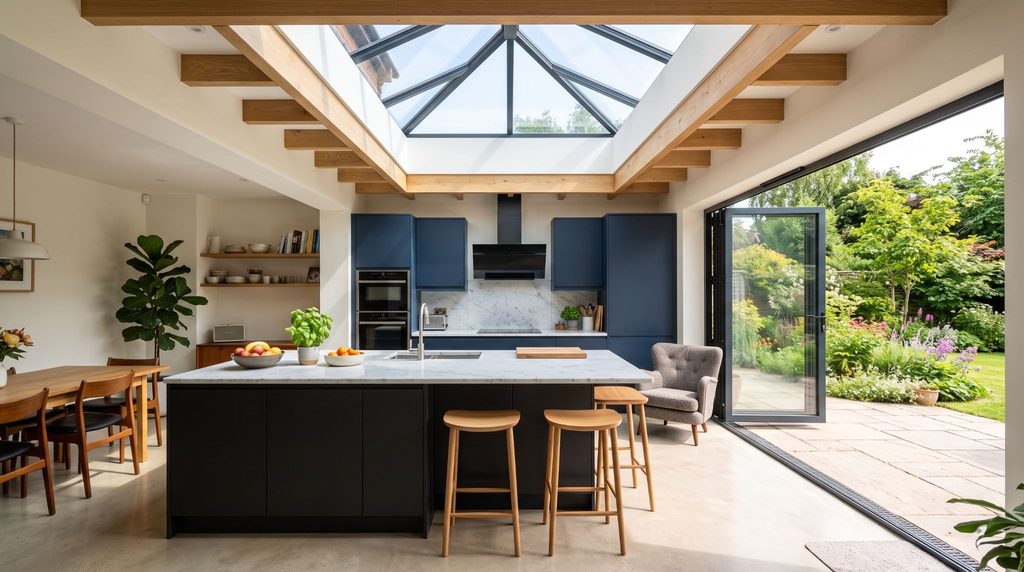
Five things move a kitchen extension quote more than anything else. Size, finish, ground conditions, structural changes and glazing. Get a handle on these before you fall for a low headline figure, because most of the gap between two quotes comes down to what each one quietly leaves out.
- Size and layout. Bigger floor areas cost more in total but less per metre. An awkward shape or a tight site pushes the rate up.
- Level of finish. A mid-range fitted kitchen runs €10,000 to €25,000, and a high-end kitchen with stone worktops and integrated appliances can pass €30,000 on its own.
- Ground and site conditions. Poor ground, high water tables or restricted access all add cost that a desktop estimate never catches.
- Structural changes. Opening the back wall for a wide steel beam, or removing walls to go open-plan, adds engineering and labour.
- Glazing and rooflights. Bifold or sliding doors and a roof lantern lift both the price and the light, and they are a common reason quotes vary so much.
Tying the new space into an older home is where a well-built house extension earns its money, especially in period Dublin properties with solid walls and shallow foundations.
How Kitchen Extension Type Affects the Price

The type of extension changes both the rate per square metre and the total. A side return uses the narrow strip of side garden. A rear extension pushes straight back. An open-plan build folds the kitchen into dining and living space, and a two-storey extension adds rooms above. Each carries a different price.
Single-Storey Kitchen Extension Cost
A single-storey kitchen extension is the most common choice and the best value per square metre. Most cost €55,000 to €175,000 all-in depending on size, or €2,500 to €3,500 per square metre for a standard to mid finish. It is the simplest structure, which keeps the rate down.
Side Return Kitchen Extension Cost
A side return kitchen extension fills the narrow gap down the side of the house, common in older Dublin terraces. It is small, usually 8 to 15 square metres, but the cost per square metre is high because the fixed costs barely change. Budget €55,000 to €90,000 for most.
Open-Plan Kitchen Extension Cost
An open-plan kitchen extension combines cooking, dining and living space in one bright room, usually 30 to 45 square metres. All-in cost runs €120,000 to €200,000. Removing internal walls to link the new and old space adds structural work, so a proper steel design matters here.
Two-Storey Kitchen Extension Cost
A two-storey kitchen extension adds a bedroom, bathroom or study above the new kitchen. It costs more in total, around €150,000 to €250,000, but less per square metre, roughly €2,000 to €3,000, because you get two floors under one roof and one set of foundations.
Do You Need Planning Permission for a Kitchen Extension?
Most single-storey kitchen extensions do not need planning permission. Since 27 July 2026, you can build up to 45 square metres to the rear of a house as exempted development, up from the old 40 square metre limit. Go beyond that, or extend to the side or front, and you will usually need to apply.
The 45 square metre exemption comes with conditions you have to meet.
- Keep all extensions built since 1964 within the 45 m² total, counting anything already added
- Leave at least 25 square metres of private open space at the rear
- Stay within height limits and do not build past the front or side building line
- For a terraced or semi-detached house, keep any first-floor extension under 12 square metres, or 20 square metres for a detached house
The increase came in under the 2026 exempted development regulations, and the full conditions are worth reading before you assume your project is exempt.
Exempt does not mean unregulated. The build must still meet building regulations for structure, fire, ventilation and energy, and any gas or electrical work must be signed off by RGI and Safe Electric registered installers.
How to Keep a Kitchen Extension On Budget
The single best way to keep a kitchen extension on budget is to fix the cost before the design, not after it. Most overspends start the same way. The design is drawn first, the tender comes back over budget, and you either redraw, cut corners or stall with fees already spent.
- Get a realistic cost range before you commission drawings, so the design is built to a figure you can actually afford
- Ask what each quote excludes, because VAT, fees, the kitchen and glazing are the usual gaps
- Keep a contingency of around 10 to 15 per cent for older houses, where the surprises live behind the walls
- Confirm the trades are directly employed rather than booked across other sites, if you want a programme that holds
A design-and-build route, where the same team costs, designs and builds, closes the gaps that open up when a separate architect, engineer and builder hand work between them. One team on one programme is far easier to hold to a price.

